
What Does Zabiha Halal Mean? Hand-Slaughtered vs Machine-Slaughtered Chicken Explained
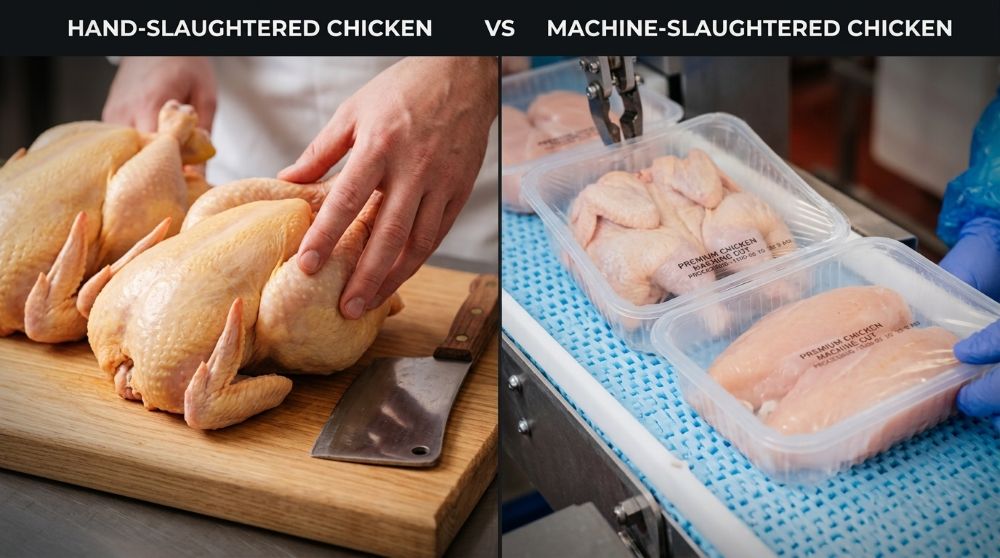
- Zabiha refers to slaughtering an animal according to Islamic law, and in Canada it usually signals hand slaughter
- Hand slaughter means a Muslim recites the name of Allah and makes each cut individually with a sharp knife
- Machine slaughter uses a rotating blade on a processing line, and the way the invocation is handled varies by plant
- Islamic scholars differ on machine slaughter, but hand slaughter is widely regarded as the ideal method
- KetKoot serves 100% halal, hand-slaughtered (zabiha) chicken from a fully halal, alcohol-free kitchen
Ask a few Muslim friends in Mississauga how they choose where to eat, and one question comes up fast: is the chicken hand-slaughtered? A halal sign in the window is a good start. For a lot of families, zabiha is the detail that settles it.

Halal, Haram, and Mushbooh: The Basics
Before getting into slaughter methods, it helps to keep three words straight.
Halal (حلال) means permissible under Islamic law. It covers what you eat and how it’s prepared.
Haram (حرام) means forbidden. Pork, lard, alcohol, and meat from animals not slaughtered according to Islamic law all fall into this category.
Mushbooh (مشبوه) means doubtful. These are ingredients with unclear origins, like certain gelatins or enzymes, that many observant Muslims avoid unless the source can be confirmed.
Zabiha sits inside halal and covers one specific thing: how the animal was slaughtered.
What Does Zabiha Mean?
Zabiha is a transliteration of the Arabic word dhabiha, the Islamic method of slaughtering an animal for food. Scholarly guidelines spell out the core conditions. The slaughterer must recite “Bismillahi Allahu Akbar” meaning, ‘In the name of Allah, Allah is the Great’ before the slaughter, use a sharp knife so the animal suffers very little, and cut the windpipe, the oesophagus, and the two jugular veins. The blood is then drained from the animal.
The emphasis on a sharp blade and a single swift cut reflects the care for the animal that runs through Islamic dietary law. It’s one reason halal is about ethics and cleanliness as much as faith, and why it means far more to Muslim families than a menu label.
In Canada, when a restaurant or butcher says its chicken is zabiha, it usually means each bird was slaughtered by hand. The word does get used loosely, though, so it’s always worth asking.
What Is Machine-Slaughtered Chicken?
Large poultry plants handle huge numbers of birds every day, and many rely on machines to keep pace. In mechanical slaughter, birds move along a line and pass over a mechanical rotating blade, often with no Muslim slaughterer making each cut or reciting the invocation over each bird.
How the tasmiyah (the invocation of Allah’s name) is handled varies from plant to plant. Some appoint a Muslim to recite it when the machine is switched on, and others play a recording. In some plants, the words are engraved on the blade, or no tasmiyah is recited at all.
Machine slaughter refers only to the cut itself. Hand-slaughtered chicken can still go through machines for plucking, cleaning, and packaging afterward. The zabiha question is about how the bird was slaughtered.

Why Scholars Differ on Machine Slaughter
This is where it pays to be careful, because Islamic scholars don’t all agree.
Some halal authorities accept machine slaughter under strict conditions. Australia’s ANIC, for example, requires an approved Muslim slaughterman, the tasmiyah recited when the rotary blade is switched on, and any bird the blade misses to be slaughtered by hand.
Many other scholars reject it. Their main concern is the tasmiyah. One widely referenced Hanafi ruling explains that most jurists require Allah’s name to be pronounced over each individual animal, without a long gap before the slaughter. A single recitation at the start of a shift can’t meet that standard. Others point out that some birds’ necks may not make full contact with the blade.
Even scholars open to machine slaughter tend to agree on one point. A research paper prepared for the Assembly of Muslim Jurists of America concludes that hand slaughter remains the ideal method, while some scholars allow mechanical slaughter only conditionally.
Muslims follow the scholars and halal authorities they trust, so families land in different places on this. Hand-slaughtered chicken is the option that sits comfortably across these views.
Hand-Slaughtered vs Machine-Slaughtered: Side-by-Side
| Hand-Slaughtered (Zabiha) | Machine-Slaughtered | |
| Who makes the cut | A Muslim slaughterer, one bird at a time | A rotating blade on a processing line |
| Tasmiyah | Recited over each bird | Varies: at switch-on, recorded, engraved, or none |
| Birds the blade misses | Not applicable | Depends on whether someone is stationed to catch them |
| Scholarly view | Widely regarded as the ideal method | Accepted conditionally by some, rejected by many |
| Speed | Slower and labour-intensive | Built for high-volume plants |
How to Check What You're Eating
A halal label tells you where a restaurant stands in general. These questions get you the details:
- Is the chicken hand-slaughtered or machine-slaughtered?
- Is the chicken stunned before slaughter?
- Do halal items share fryers, grills, oil, or prep surfaces with anything non-halal?
- Is there any alcohol in the kitchen, including cooking wine or alcohol-based extracts?
- Are ingredients like gelatin or enzymes from a confirmed source?
A clear, specific answer from the owner or staff tells you far more than a sticker on the door. Practices can change when suppliers or ownership change, so it’s worth checking again even at places you’ve visited before.
How KetKoot Handles Halal
At KetKoot, the answers are simple. All chicken is 100% halal and hand-slaughtered according to the zabiha method. KetKoot is Muslim-owned, and the entire kitchen is halal. There’s no non-halal food anywhere on the line, so nothing shares a grill, fryer oil, or utensils with it. The menu is completely alcohol-free.
Then comes the part people line up for. Every piece of chicken soaks in a garlic, citrus, and warm spice marinade for 36 hours before it’s chargrilled to order. The edges char, the outside caramelizes, and the meat stays juicy underneath. From there it goes into Musahab wraps, sliders on toasted garlic buns, rice bowls, and whole chicken platters made for the family table.
For Muslim diners, KetKoot is a place to eat without second-guessing anything. For everyone else in Mississauga, it’s bold Iraqi-inspired chicken worth the drive to Ridgeway Plaza, and the table is open to all.
Frequently Asked Questions
Is zabiha the same as halal?
Zabiha is part of halal. Halal covers everything that’s permissible, from ingredients to how food is prepared. Zabiha refers specifically to slaughtering an animal according to Islamic law.
Is machine-slaughtered chicken halal?
It depends on the scholars you follow. Some halal authorities accept it under strict conditions, while many scholars do not. If it matters to you, ask the restaurant directly how its chicken is slaughtered.
Can non-Muslims eat zabiha chicken?
Yes. Zabiha describes how the meat was slaughtered, and anyone can enjoy it.
Is KetKoot's chicken zabiha?
Yes. All of KetKoot’s chicken is 100% halal and hand-slaughtered under the zabiha method, and the whole kitchen is halal.
Does KetKoot serve alcohol?
No. KetKoot’s menu is completely alcohol-free.
Find Hand-Slaughtered, Chargrilled Chicken in Mississauga
When you know exactly how your chicken was slaughtered, you can stop asking questions and dig in. KetKoot serves 100% halal, hand-slaughtered chicken, marinated for 36 hours and chargrilled to order, at Ridgeway Plaza, a short drive from Churchill Meadows, Erin Mills, and Meadowvale.
You’ll find KetKoot at 3450 Platinum Drive, Unit 11, Mississauga, Ontario L5M 2S4. It’s open Monday to Thursday and Sunday from 11 a.m. to 1 a.m., and Friday and Saturday from 11 a.m. to 2 a.m. Hours can shift around holidays and Ramadan, so call (905) 828-8585 or check the Google listing before you head over. Delivery is available through Uber Eats and other delivery apps.